

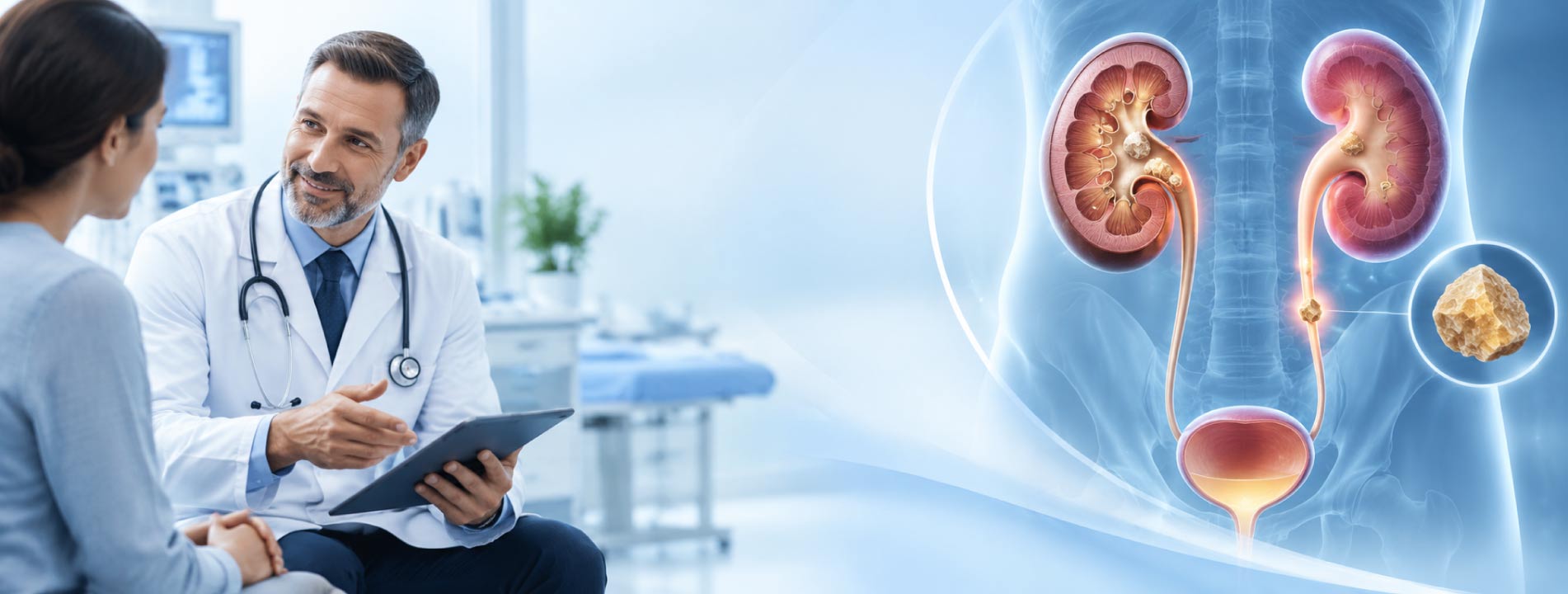
Kidney stones are one of the most painful conditions a person can experience, and they are becoming increasingly common due to dehydration, diet, and lifestyle factors. These stones can also affect the ureter and bladder and may vary in their composition and size.
Kidney Stone Treatment in Basavangudi, Bangalore has become far more advanced over the last decade. Many patients who once feared surgery can now undergo minimally invasive procedures with shorter hospital stays and faster recovery.
Small stones may pass on their own with adequate fluid intake and appropriate medical guidance. Larger or obstructive stones may require medical treatment. A consultation with a Urologist in Basavangudi, Bangalore can help determine the appropriate treatment approach. A Kidney Stone Specialist in Basavangudi, Bangalore may recommend laser-assisted or minimally invasive procedures that avoid large surgical incisions.
Symptoms, Causes & Risk Factors of Kidney Stones
Recognising the symptoms of kidney stones early can help reduce the risk of complications such as urinary infection, obstruction, or kidney damage.
Common Symptoms
- Severe flank pain: Kidney stone pain commonly develops on one side of the back or flank and may be intense.
- Pain radiating to the lower abdomen or groin: Pain may move towards the lower abdomen or groin as the stone travels through the urinary tract.
- Blood in the urine: Also known as haematuria, blood may be visible in the urine or detected during a urine test.
- Burning sensation during urination: Pain or burning while urinating may occur, particularly when the stone reaches the lower urinary tract.
- Frequent urination: Some patients may feel the need to urinate more often than usual.
- Nausea and vomiting: Severe kidney stone pain may sometimes be accompanied by nausea or vomiting.
- Fever and chills: Fever or chills may indicate an associated urinary infection and require prompt medical evaluation.
- Difficulty passing urine: A stone causing urinary obstruction may make urination difficult and should be evaluated promptly.
Common Causes
Dehydration is an important factor in kidney stone formation because low fluid intake can make the urine more concentrated. A high concentration of minerals and substances such as calcium, uric acid, struvite, or cystine can also contribute to stone formation.
Certain metabolic conditions may increase the likelihood of developing kidney stones, even when dietary factors are not the primary cause.
Risk Factors
- Previous history of kidney stones
- Low fluid intake
- High-sodium diet
- High animal protein intake
- Obesity
- Diabetes
- Recurrent urinary tract infections
- Certain medications
Diagnosis of Kidney Stones
Clinical Assessment
A doctor usually begins with a detailed medical history and clinical assessment. This may include questions about the nature and location of pain, previous kidney stones, urinary symptoms, and any family history of kidney stone disease.
Diagnostic Tests
Kidney stone diagnosis may involve a combination of imaging and laboratory tests.
- Ultrasound KUB: An ultrasound of the kidneys, ureters, and bladder can help identify stones and urinary obstruction without using radiation.
- CT Scan: A CT scan for kidney stones can provide detailed information about the size, number, and location of stones.
- X-ray KUB: X-rays may help identify certain types of stones, particularly calcium-containing stones. Some stones, including certain uric acid stones, may not be clearly visible on a standard X-ray.
- Urine Tests: Urine testing may help identify infection, blood in the urine, and crystal formation.
- Blood Tests: Blood tests may be used to assess kidney function and metabolic factors associated with stone formation.
- Stone Analysis: If a stone passes naturally or is removed during treatment, laboratory analysis can help determine its composition.
A complete kidney stone evaluation helps the doctor determine the most appropriate treatment approach and assess factors that may contribute to future stone formation.
Kidney Stone Treatment Options
Conservative (Medical) Management
Small stones that are unlikely to cause complications may be managed without surgery. Depending on the size and location of the stone, treatment may include:
- Adequate daily fluid intake
- Pain-relief medication when required
- Medical expulsive therapy to help relax the ureter in selected cases
- Monitoring symptoms and stone movement
- Periodic follow-up imaging when recommended
Advanced Minimally Invasive Procedures
Larger stones, obstructive stones, or stones that do not pass naturally may require a procedure. Laser kidney stone treatment can be used to break stones into smaller fragments so they can either be removed or pass through the urinary tract more easily.
RIRS and PCNL are among the commonly used techniques for minimally invasive kidney stone surgery. These procedures are designed to treat stones through small or natural access routes rather than large surgical incisions.
For larger, complex, or recurrent stones, kidney stone removal surgery may be recommended based on the size, location, and complexity of the stone.
Urinary stone treatment may also include treatment for stones located in the ureter or bladder. The treatment approach depends on the location of the stone and whether it is causing obstruction, infection, pain, or other urinary symptoms.
Open or Laparoscopic Stone Surgery (Rare Cases)
Open or laparoscopic surgery is now required less frequently because many kidney stones can be treated using endoscopic, laser, or minimally invasive procedures.
However, these approaches may still be considered in selected complex cases, such as very large stones, certain staghorn stones, anatomical abnormalities, or situations where other procedures are not suitable.
Why Choose Dr Vishnu Prasad for Kidney Stone Treatment in Basavangudi, Bangalore?
Dr Vishnu Prasad has experience in the evaluation and treatment of both simple and complex kidney stone conditions. His clinical expertise includes minimally invasive urology, robotic surgery, uro-oncology, and the management of a range of urinary and urological conditions.
Patients looking for a Kidney Stone Specialist in Basavangudi, Bangalore can consult Dr Vishnu Prasad for an assessment of the size, location, and type of kidney stone and to determine whether medical management, laser treatment, or a minimally invasive procedure may be appropriate.
Persistent or severe kidney stone symptoms should be evaluated promptly, particularly when pain is accompanied by fever, vomiting, difficulty passing urine, or other concerning symptoms.
Book an appointment with Dr Vishnu Prasad for evaluation and appropriate kidney stone treatment.
Frequently Asked Questions
The stone’s size and location determine what a doctor recommends. A 4mm stone might just need fluids and monitoring. A 9mm stone blocking the ureter is a different case entirely and usually needs a procedure.
Many do, especially under 5mm, given enough water intake and a bit of patience. Once a stone crosses that size, waiting it out gets riskier.
Doctors turn to laser when a stone won’t pass on its own or is already causing a blockage or infection.
Anaesthesia handles the pain during the procedure itself. Afterwards, most patients manage recovery with standard medication.
Consult a urologist with experience in stone disease. Dr Vishnu Prasad manages medical treatment for kidney stones. He also performs surgical procedures directly.