

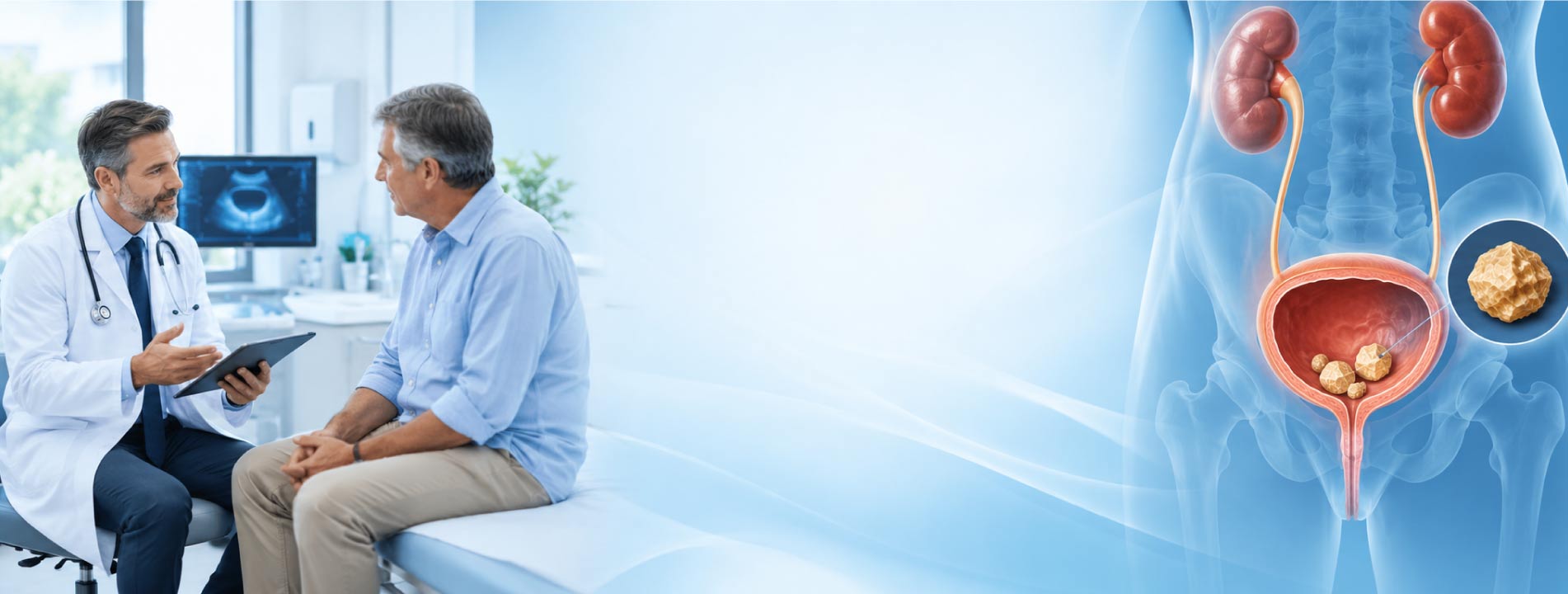
Bladder stones, also called vesical calculi, are hard mineral deposits that can form inside the bladder when urine is not emptied completely. Urine that remains in the bladder for too long may allow minerals such as calcium and uric acid to crystallise and gradually form stones.
If left untreated, bladder stones can cause urinary symptoms, recurrent infections, pain, or bladder-related complications. Patients looking for bladder stone treatment in Basavangudi, Bangalore may benefit from an evaluation to identify both the stone and the underlying cause.
Symptoms, Causes & Risk Factors of Bladder Stones
Bladder stones can irritate the bladder lining and may contribute to recurrent urinary symptoms or infections. Recognising the symptoms early can help patients seek timely evaluation and treatment.
Symptoms of Bladder Stones
- Pain or heaviness in the lower abdomen
- Burning or discomfort while urinating
- Frequent urination
- Straining to pass urine or a weak urinary stream
- Blood in the urine (hematuria)
- Urine flow that stops and starts
- Cloudy or darker-than-usual urine
- Recurrent urinary tract infections
Consulting a bladder stone specialist in Basavangudi, Bangalore when symptoms persist can help identify the cause and reduce the risk of complications.
Common Causes
- Incomplete bladder emptying
- Enlarged prostate (Benign Prostatic Hyperplasia)
- Neurogenic bladder
- Bladder outlet obstruction
- Urinary tract infections
- Bladder diverticula
- Foreign bodies or urinary catheters
In men, an enlarged prostate can contribute to bladder stone formation by partially obstructing urine flow and leaving residual urine in the bladder after urination. Neurogenic bladder can also lead to incomplete bladder emptying in patients with certain neurological or spinal conditions.
Risk Factors
- Older age
- Male gender
- Previous history of bladder stones
- Chronic urinary retention
- Spinal cord disorders
- Dehydration
Bladder stones are more commonly seen in men with prostate enlargement, but they can also affect women and younger patients, particularly those with urinary tract abnormalities, long-term catheter use, or bladder-emptying problems.
Diagnosis of Bladder Stones
A bladder stone diagnosis helps confirm the presence, size, and location of the stone. It is also important to identify the underlying reason the stone formed, as untreated causes may increase the risk of recurrence.
Clinical Assessment
The evaluation usually begins with a review of the patient’s symptoms, medical history, previous urinary problems, and any history of bladder stones. A physical examination may also be performed to assess lower abdominal tenderness or signs of urinary retention.
Diagnostic Tests
- Urinalysis: A urine test may help identify infection, blood in the urine, or other urinary abnormalities.
- Blood Tests: Blood tests may be used to assess kidney function and identify signs of infection or other contributing conditions.
- Ultrasound KUB: An ultrasound of the kidneys, ureters, and bladder can help identify bladder stones and assess the urinary system.
- X-ray KUB: An X-ray may help identify certain types of bladder stones and provide information about their location and density.
- CT Scan: A CT scan for bladder stones may provide more detailed information when smaller or less easily visible stones are suspected.
- Cystoscopy: Cystoscopy involves passing a thin scope through the urethra to directly examine the bladder and identify the stone.
Imaging and cystoscopic evaluation can help the doctor determine the most appropriate treatment approach. These techniques are commonly used in modern endourology.
Bladder Stone Treatment Options
The appropriate treatment depends on the size and number of stones, severity of symptoms, bladder function, and the underlying cause of stone formation.
Conservative Management
Small bladder stones that are not causing significant symptoms may sometimes be monitored. Depending on the clinical situation, the doctor may recommend increased fluid intake, symptom management, and follow-up evaluation.
Cystolitholapaxy (Endoscopic Bladder Stone Removal)
Cystolitholapaxy is a commonly used minimally invasive procedure for bladder stone removal. A scope is passed through the urethra into the bladder, where the stone is fragmented using laser, ultrasound, or another appropriate energy source.
The fragments are then removed or flushed from the bladder. Because the procedure is performed through the urinary passage, it usually does not require an external abdominal incision.
Laser Bladder Stone Treatment
Laser bladder stone treatment, also known as laser lithotripsy, uses focused laser energy to break the stone into smaller fragments. These fragments can then be removed through the endoscope.
Laser treatment may be considered for different types and sizes of bladder stones depending on the clinical situation and the surgeon’s assessment.
Open or Robotic Surgery (Selected Cases)
Open or robotic surgery may be considered in selected complex cases, including very large stones, multiple stones that cannot be cleared endoscopically, bladder abnormalities, or situations where another underlying condition needs to be treated at the same time.
Bladder stone removal surgery may therefore involve treatment of both the stone and the condition contributing to its formation, such as bladder outlet obstruction or prostate enlargement.
For many patients, however, modern bladder stone surgery can be performed using minimally invasive bladder stone surgery techniques through the urinary tract without a large abdominal incision.
Recovery After Bladder Stone Treatment
Recovery after bladder stone surgery is usually faster after endoscopic procedures than after open surgery. Depending on the type of procedure and the patient’s condition, discharge may be possible on the same day or after a short hospital stay.
A urinary catheter may sometimes be kept in place temporarily to allow the bladder to heal. The doctor will provide instructions regarding catheter care, fluid intake, activity, and medications.
Patients are often advised to drink adequate water after treatment to support urinary flow and help clear small residual fragments. Mild burning or discomfort during urination may occur for a short period after the procedure.
Heavy lifting or strenuous activity may need to be avoided temporarily, depending on the type of treatment performed and the doctor’s advice.
Follow-up may include a urine test and, when required, repeat imaging such as an ultrasound to confirm that the bladder is clear and assess recovery.
Patients should seek prompt medical attention if they develop fever, worsening pain, difficulty passing urine, or significant bleeding after treatment.
Why Choose Dr Vishnu Prasad for Bladder Stone Treatment in Basavangudi, Bangalore?
Dr Vishnu Prasad has specialised training and experience in urology, uro-oncology, robotic surgery, and minimally invasive urological procedures. His clinical practice includes the diagnosis and treatment of bladder stones and other urinary conditions that may contribute to stone formation.
Patients looking for a bladder stone specialist in Basavangudi, Bangalore can consult Dr Vishnu Prasad for an evaluation of the stone’s size, number, location, and underlying cause, followed by an appropriate treatment plan.
As a robotic surgeon in Basavangudi, Bangalore, Dr Vishnu Prasad also manages selected complex urological conditions where advanced minimally invasive or robotic techniques may be appropriate.
Book an appointment with Dr Vishnu Prasad for evaluation and appropriate bladder stone treatment.
Frequently Asked Questions
Bladder stones form when the bladder doesn’t empty fully, giving minerals in the urine time to crystallise. An enlarged prostate is the most common reason behind this. Nerve-related bladder problems and long-term catheter use can cause it too.
A very small stone with no symptoms sometimes passes on its own if you drink enough water. Once a stone gets larger, natural passage becomes unlikely, and a procedure is usually needed to remove it.
Persistent symptoms or recurrent infections are usually the trigger for surgery. If there are multiple stones, or the bladder itself has an abnormality, surgery tends to be the next step.
Drinking enough water each day goes a long way toward preventing stone formation. Treat urinary infections as soon as they show up, and don’t ignore an enlarged prostate. Both can turn into bladder stones if left unaddressed.
Look for a urologist with hands-on experience in endoscopic and laser stone treatment. That’s the specialist who can efficiently handle both the diagnosis and the treatment plan from start to finish.